
On a busy farm, jobs rarely arrive one at a time. A crop needs checking, a spraying window opens and there is still that awkward patch of weeds to deal with. Agricultural drones give growers another way to handle some of that work. Depending on the aircraft and equipment, they can collect crop imagery, carry out suitable spraying applications or spread seed and granular fertiliser.
Where do they make a difference in day-to-day farming? We look at the work they do, the crops and paddocks where they are useful, and what it takes to run them in the field. There is also a documented wheat-spraying job from Deniliquin, NSW, with figures from the farm itself.
What can a farm drone actually do?
There are three distinct jobs to think about: seeing the crop, applying a spray and spreading material. Different drones and attachments are used for different tasks, so it helps to look at what each one brings to the paddock.

Aerial imagery helps show variation across a block or orchard, giving you a clearer idea of where to look more closely.

When the crop and weather conditions line up, a spraying drone provides another way to carry out a planned crop-protection treatment.

Scattered weed patches, paddock edges and uneven country are places where approaching the job from above may be useful.
There is also spreading. With compatible equipment, some agricultural drones can distribute suitable seed and granular fertiliser. That opens up a different set of jobs from crop spraying, particularly where the material and field conditions suit aerial application.
How agricultural drones solve problems across different crops
Every crop brings its own jobs. From protecting wheat at a key growth stage to managing weeds in grazing paddocks, agricultural drones help growers get spraying, crop checks and spreading work done where it matters.
Wheat, canola and cotton
In large paddocks, weeds, insects and crop disease can create urgent jobs across different areas of the crop. Agricultural drones follow planned routes to spray the wheat, canola and cotton blocks that need treatment, helping growers respond promptly during busy growing periods. The wheat case study below shows how drone spraying was used on a working Australian farm.
Sugarcane, bananas and maize
As sugarcane, banana plants and maize grow taller, dense rows make parts of the crop difficult to reach. Agricultural spraying drones work above the plants and treat designated areas along planned flight paths. Growers can carry out crop-protection jobs across tall blocks without having to move through the rows. Our Queensland sugarcane story shows this approach in the field.
Grapes, potatoes, tomatoes and vegetables
Vineyards, orchards and vegetable blocks need regular attention to weeds, pests and crop health, often in specific rows or sections. Agricultural drones help growers check crop conditions from above and spray the areas marked for treatment. That makes it easier to manage work across grape vines, fruit trees, potatoes, tomatoes and other vegetable crops, one block at a time.
Weed control, grass seed and fertiliser
Scattered weeds need targeted treatment, while thin or worn pasture needs reseeding and fertiliser as part of its renewal. Agricultural drones spray identified weed patches, spread grass seed and apply suitable granular fertiliser to planned areas. Graziers can tackle pasture maintenance across large grazing properties with a clear job for each flight.
Phil’s wheat farm: a job with real figures
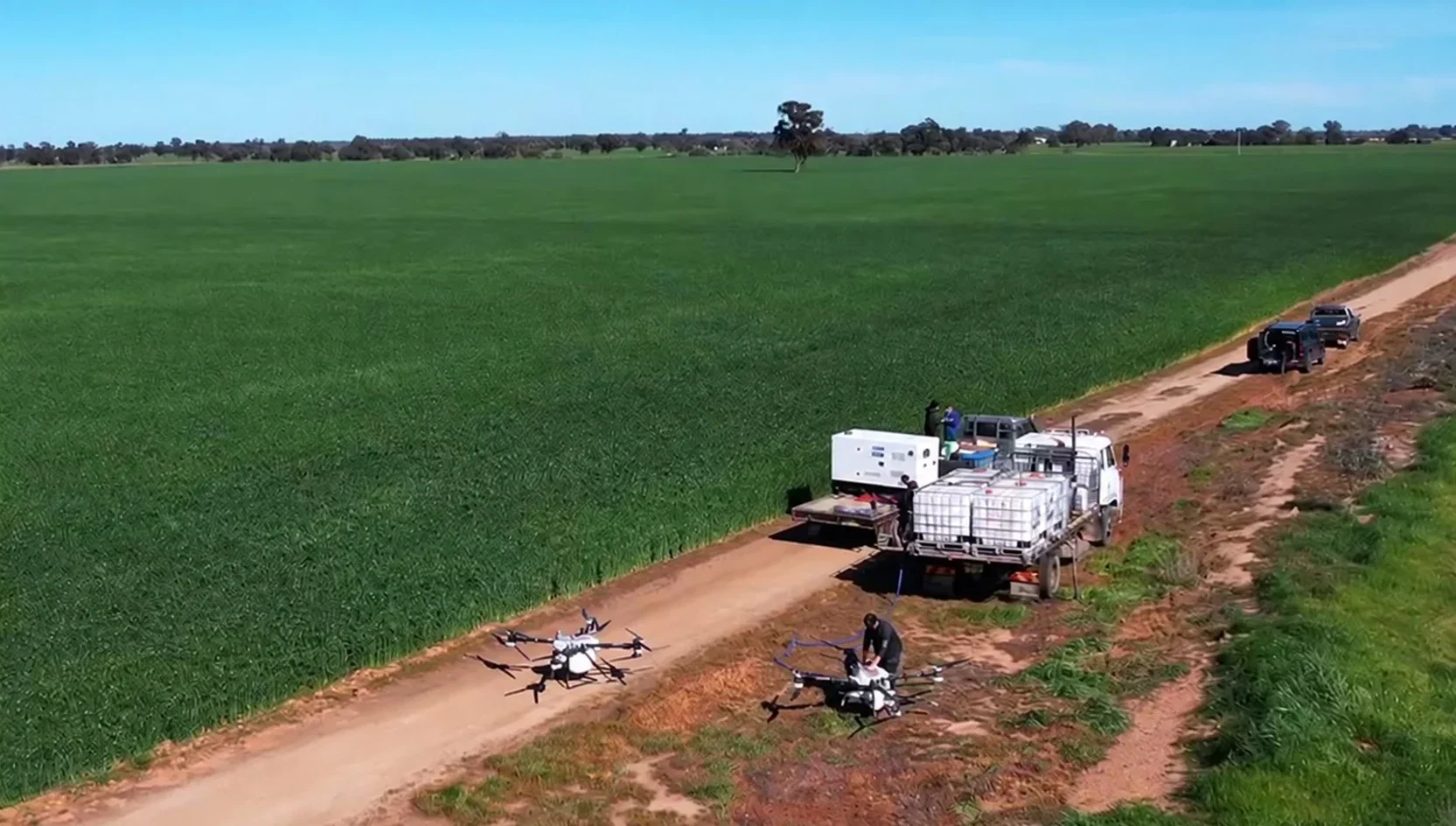
Phil farms about 1,500 hectares of wheat near Deniliquin in southern New South Wales. His field report is useful because it records an actual fungicide job, including the area treated, the aircraft used and the time taken.
EE Talk With Phil — Wheat Management Workflow
Phil talks through his wheat-management work in the video. The field report below shows the area treated, the drones used and the time taken.
Fungicide spraying at flag-leaf stage
At the flag-leaf stage, two operators used two DJI Agras T100 drones to apply fungicide. The team treated 235 hectares in seven hours.
The field report also records an application volume of 30 L/ha, alongside the area covered and time on the job.
Read the Deniliquin wheat drone spraying field reportWhere could a drone make a difference on your property?
Every grower knows the jobs that put pressure on the season. Perhaps there is a treatment that needs doing while conditions are right, a scattered weed problem, or a block that needs checking before the next decision. Those are the situations in which the role of a drone becomes much clearer.
Getting a treatment done at the right time
A useful application window does not always last long. Aerial spraying gives growers another way to organise a crop-protection job during that period.
Working across difficult ground
An isolated patch or uneven section may be difficult to reach from within the paddock. A drone approaches the area from above.
Knowing where to look more closely
Crop imagery can show patterns across a block that are easy to miss from one spot. Those patterns help guide a closer inspection.
Fitting aerial work into the season
Spraying, suitable spreading jobs and crop inspections can be considered alongside the rest of the farm’s seasonal programme.
How a drone operation comes together in the field
The aircraft is only part of a working drone operation. There is also a flight plan, a crew and, for application jobs, a practical system for charging, filling and handling materials. When those pieces work together, aerial work becomes something you can schedule with the rest of the farm.
Identify the areas, application volumes and crop work that need to be covered through the season.
Choose the aircraft and attachments for the work involved, whether that is spraying, spreading or field imagery.
Organise the crew, take-off area, batteries and refilling arrangements around the paddock and the job.
Keep track of area covered and working time. Those figures are useful when planning later jobs.
Choosing equipment for the work you have
The right aircraft depends on how you farm. A compact model may suit scattered blocks; a larger workload puts more emphasis on capacity and the time spent between refills. Compare the whole day’s work, not just the aircraft specification. The DJI Agras model guide is a useful place to look at the available options.
| Farm job | Worth looking at | How aerial work fits |
|---|---|---|
| Small patches and scattered blocks | Moving between blocks and how much equipment the crew needs to bring. | Targeted applications for isolated patches and separate small areas. |
| Repeated crop spraying | Application volume, filling time and battery turnaround. | Planning crop-protection work around suitable growth stages and weather windows. |
| Granular spreading | The material being spread, feeder type and calibration. | Distribution of suitable seed or granular fertiliser from the air. |
| Crop mapping and field checks | The imagery needed to answer a specific crop-management question. | A broader view that points you towards areas needing closer inspection. |
Tank capacity tells only part of the story. Battery turnaround, filling arrangements and the people on the job also affect how smoothly an application runs.
Finding the right DJI Agras model
There is no single Agras model for every farm. The T25P, T50, T70P and T100 offer different capacities and operating arrangements. The choice comes back to the size and layout of the paddocks, the work planned and how the crew will run it. Check the Australian configuration and equipment offered with each model.
| Model | Where it may suit | What to consider |
|---|---|---|
| DJI Agras T25P | Smaller properties, orchards, vineyards and scattered blocks. | A compact aircraft where moving between separate areas is part of the job. |
| DJI Agras T50 | Growers looking for an established Agras platform for suitable spraying and spreading work. | How the aircraft and application equipment fit the planned seasonal workload. |
| DJI Agras T70P | Mixed farms and larger application programmes where more capacity is useful. | Application volumes, field logistics and turnaround between loads. |
| DJI Agras T100 | Broadacre work and larger field operations, including the wheat spraying described in Phil’s report. | The full field set-up. Phil’s recorded job used two T100 aircraft and two operators. |
Specifications become more useful once the jobs are clear. You can see more about the aircraft and available application systems in the DJI Agras range.
What gives an agricultural drone value on a farm?
No single hectares-per-day figure will tell you whether an agricultural drone is a worthwhile investment. Look at the work you expect it to do across the year and the cost of running it properly. A DJI Agras system includes more than the aircraft itself.
- The full working package Account for batteries, charging equipment, the controller, spraying or spreading attachments, training and service support.
- How the field work will run A practical filling and charging arrangement affects what can be completed during the working day.
- The annual workload Use actual hectares, expected application volumes and the number of jobs through the season in your calculations.
- Service and parts Access to repairs, spare parts and knowledgeable local support matters when equipment is needed during the season.
Work the numbers against your hectares
Start with the hectares and jobs you expect to cover in a year. Allow for annual costs such as depreciation, finance, insurance and servicing, then add labour, transport, charging and consumables for each operation. For example, if annual fixed costs are A$10,000 across 500 hectares, that works out to A$20/ha before running costs.
The figures sit alongside the value of the work itself — including a time-sensitive application or a part of the property that is difficult to access.
The people behind a well-run drone job
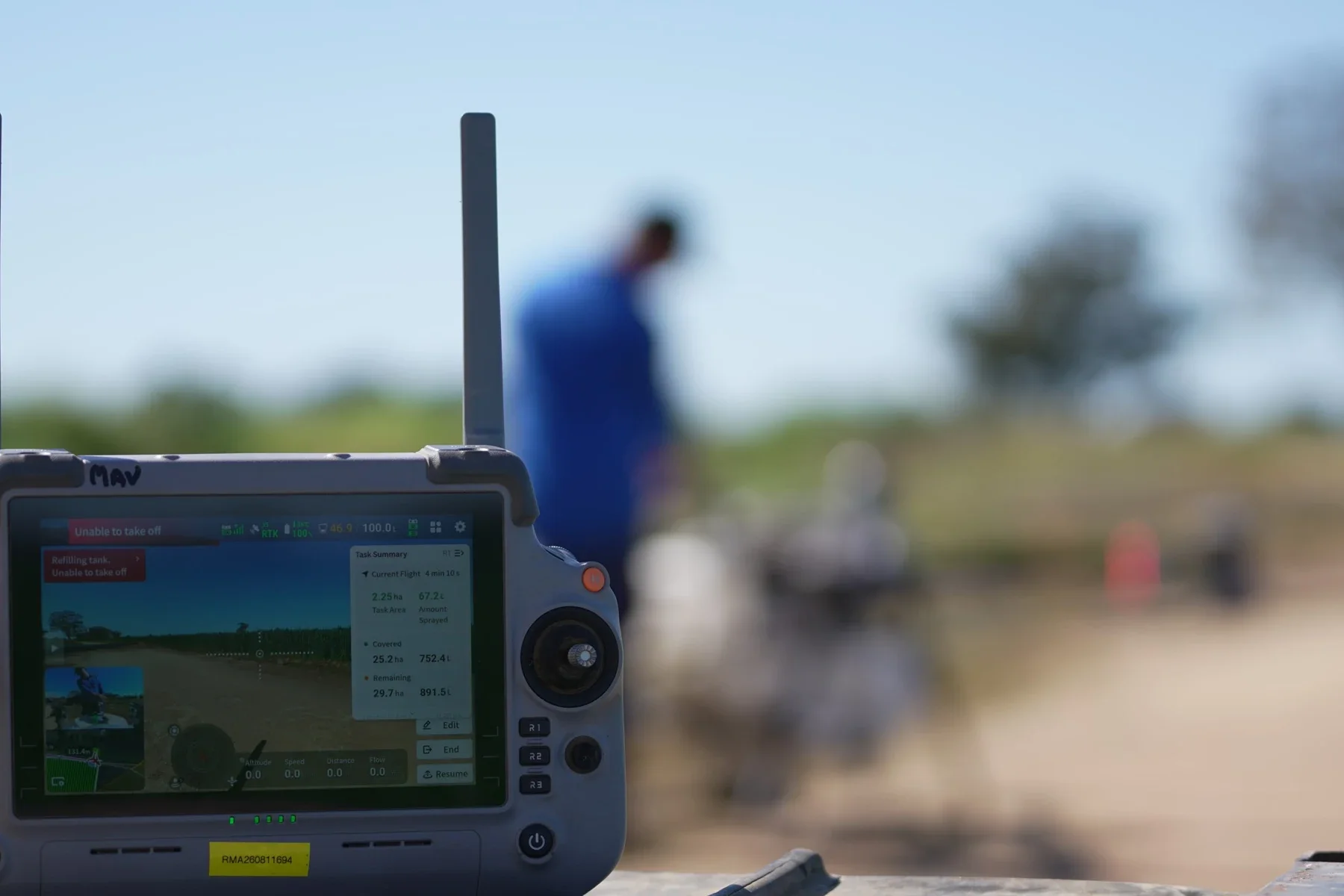
Flying the aircraft is only one part of agricultural drone work. Operators also need to understand the job in the paddock: how the route is set, what application settings are needed and what the crew does between flights. Practical training puts those decisions into a real farming context.
Skills that matter in the field
- Planning flight routes around real paddock layouts
- Checking application rates and spray coverage
- Reading the conditions before an application
- Managing batteries, refilling and equipment care
- Responding when a flight or field plan needs to change
Field-based instruction is especially useful because it connects the controls and application settings to the agricultural work an operator will be doing.
Operating agricultural drones in Australia
In Australia, the requirements for an agricultural drone depend on the aircraft and the type of flying involved. Agricultural chemical applications have their own rules as well. Those details are part of organising the job; the information below provides a starting point, with links to the official sources. Requirements can vary between states and territories.
Australian flight and chemical-use requirements
For eligible landholder-excluded flights, you generally don't need a RePL or ReOC. You do need operator accreditation, drone registration, standard operating conditions and the required records.
For eligible landholder-excluded flights, you need a RePL suitable for the aircraft. A ReOC may not be required under that exclusion; other operating conditions still apply.
If you're being paid, don't assume the landholder exclusion covers you. Commercial work generally requires a properly licensed pilot and a ReOC-authorised operator.
Being allowed to fly doesn't automatically mean you can spray. The product label or an APVMA permit must allow the intended application, and state chemical licences may be needed even on your own land. In Victoria, for example, agricultural drone spraying requires specific operator and pilot chemical licences. Check the rules for your state and the actual product before you schedule a job.
CASA: drone weight categories and requirements ↗ · Example: Agriculture Victoria drone spraying rules ↗
Questions growers ask about agricultural drones
These are the practical questions that come up when you begin working out what a drone could do on your property.
Will an agricultural drone fit into the way we already manage our paddocks?
A drone slots into everyday paddock work. You can use it for crop checks, spraying and spreading as part of your usual seasonal routine, with each job scheduled around what’s happening on the farm.
Which jobs are growers actually using drones for?
Common uses include crop checks, time-sensitive spraying, weed patches that are difficult to reach and suitable seed or granular fertiliser spreading. The best application depends on the crop and the job.
How many hectares can a spraying drone cover in a day?
There is no useful single figure for every farm. Application volume, field layout, refilling, batteries, crew and weather all affect the result. In Phil’s published wheat operation, two T100 drones treated 235 hectares in seven hours. Daily coverage varies with the field layout, application volume and job set-up.
What about a wet or awkward corner of a paddock?
Wet corners and awkward patches are exactly where a spraying drone comes in handy. It works from above, so you don’t have to drive through difficult ground. You can set up on firm ground nearby and carry out the planned treatment using an approved product.
Can it spread the seed or fertiliser we already use?
Agricultural drones can spread a wide range of farm seeds and granular fertilisers, including grass seed and fertiliser used in pasture management. The spreading system can be adjusted to suit different materials and application rates.
What else do we need besides the drone?
For spraying or spreading, plan for batteries, charging, refilling, the right application attachments and trained operators. The field set-up will depend on the aircraft and the work being carried out.
Do I need a licence to fly a drone on my own farm?
That depends on the aircraft weight and how it is being operated. Eligible landholder operations can have different CASA requirements from paid commercial work. Chemical spraying has separate requirements. The Australian operating section above links to the relevant guidance.
How do I work out whether the investment makes sense?
Start with the work the drone would do over a full season. Use your hectares, application volumes and likely operating days to estimate costs, including the aircraft, support equipment, people and servicing. Then assess that against the value of completing those farm jobs.
Are agricultural drones useful outside broadacre cropping?
Agricultural drones are used well beyond broadacre crops, including sugarcane, orchards, vineyards and pasture management. Growers use them for crop checks, spraying and targeted pasture work, with equipment selected for the job.
Which DJI Agras would suit our farm?
Look at the size and layout of the blocks, the application work planned and the crew and support equipment available. The T25P, T50, T70P and T100 suit different workloads. Tank capacity alone will not tell you which set-up is right.
A useful tool for jobs that need doing
Growers are interested in what gets done in the paddock, not just what a machine can do on paper. Agricultural drones help growers carry out crop checks, spraying and spreading work throughout the season. Phil’s wheat operation is one documented example of how a drone programme can fit into a working farm.
Read more about DJI Agriculture at EE Group and its applications in Australia, or discuss agricultural drone solutions for your property.
For more information about agricultural drone operations and spraying in Australia, visit the official CASA and APVMA resources below.