

DJI Agriculture Drones in Australia
Precision in Every Flight. Performance in Every Field.
Discover DJI Agriculture drones designed for Australian farming. From precision crop spraying and efficient spreading to heavy-duty lifting, explore advanced drone solutions that enhance productivity, optimise resources and support modern agricultural operations.
Explore the RangeAgricultural Drone Solutionsfor Modern Australian Farming
Discover how DJI Agriculture drones support efficient crop spraying, precision spreading, large-scale farm operations and data-informed crop management. Designed for a wide range of agricultural applications, DJI Agras drones help Australian growers improve field coverage, streamline workflows and make more efficient use of time and resources.

Agricultural Drone Spraying for Precise Crop Protection
DJI Agras spraying drones support targeted application across a wide range of crops and field conditions. From broadacre farming to more complex terrain, agricultural drone spraying can help growers manage crop protection tasks with consistent coverage, flexible operation and efficient field workflows.
Planning a crop spraying mission involves the target crop, canopy characteristics, weather conditions, field access, flight paths and application settings. Operators must also consider applicable chemical label directions and Australian operating requirements. For a real-world Australian example, see our DJI Agras T100 wheat spraying case study, which describes reported work on a New South Wales farm.
Explore Agricultural Drone Spraying Solutions
Precision Fertiliser and Seed Spreading with Agricultural Drones
DJI Agriculture spreading systems offer a flexible solution for applying granular fertiliser, seeds and other compatible materials. With suitable equipment configurations and application settings, drone spreading can support efficient distribution across different crops, terrain and field conditions.
Successful drone spreading begins with checking material compatibility, granule characteristics, equipment calibration and the intended application rate. Paddock size, refill logistics and local conditions also influence workflow planning. Explore the DJI Agras T50 spraying and spreading system for an example of a model designed for both application types. For more compact operations, the DJI Agras T25P offers a foldable option for agricultural spraying and spreading.

Agricultural Drone Lifting for Farm Logistics
DJI Agras T100 and T70P drones support aerial lifting and transport of agricultural supplies, including saplings, fertiliser and other suitable materials. With real-time load monitoring, automatic balance control and assisted navigation between loading and unloading points, operators can plan material-handling tasks across large or difficult-to-access properties. Payload limits and operations are subject to aircraft configuration, site conditions and applicable Australian regulations.
Before planning a lifting task, assess the load, attachment method, route, terrain, loading areas and the limits applicable to the operation. Compare the DJI Agras T100 and DJI Agras T70P for model-specific equipment information. Manufacturer-rated payloads do not override Australian operational restrictions.

Precision Agriculture and Smarter Crop Management
Combine planned flight operations with field observations, mapping data and agronomic advice to support more informed crop management. DJI Agriculture technology can form part of a precision farming workflow, helping growers plan targeted applications and adapt their approach to changing field conditions.
A typical workflow may move from field scouting and multispectral image capture to crop analysis, prescription planning and an appropriately configured field application. Learn how weed detection and targeted spraying can fit into this process, or explore our precision agriculture mapping and monitoring guide. The DJI Mavic 3M is one option for collecting multispectral crop data.
The DJI Agriculture Range
From compact solo operations to large-scale commercial work, explore the model that fits your farm and workflow.
DJI Agras T100
Built for large-scale agricultural operations.

DJI Agras T70P
Versatile spraying, spreading and lifting with Safety System 3.0.

DJI Agras T50
Precision spraying and spreading with a coaxial twin-rotor design.

DJI Agras T25P
Compact, foldable and designed for flexible agricultural operations.

DJI Mavic 3M
Multispectral imaging for precision agriculture and crop monitoring.

*Specifications represent manufacturer-rated maximum capacities and may vary with configuration and operating conditions. All operations must comply with applicable CASA regulations and state or territory requirements for agricultural chemical application.
*Australian Operating Notice: The maximum take-off weight for operations within the relevant Australian regulatory category is 149.9 kg. Operators must ensure that the drone’s total take-off weight, including the aircraft, payload and accessories, remains within applicable regulatory limits and complies with CASA requirements.
Compare Featured Drones
See how the DJI Agras range lines up on payload, flow rate and key capabilities.
 DJI Agras T100 |
 DJI Agras T70P |
 DJI Agras T50 |
 DJI Agras T25P |
|
|---|---|---|---|---|
| Best for | Large-scale operations | Versatile spraying, spreading and lifting | Precision spraying and spreading | Compact, solo operations |
| SPRAYING | ||||
| Spraying payload (tank) | 100 kg (100 L) | 70 kg (70 L) | 40 kg (40 L) | 20 kg (20 L) |
| Spraying flow rate | 30 L/min (2 sprinklers)40 L/min (4 sprinklers, optional) | 30 L/min (2 sprinklers)40 L/min (4 sprinklers, optional) | 16 L/min (2 sprinklers)24 L/min (4 sprinklers, optional) | 16 L/min (2 sprinklers)24 L/min (4 sprinklers, optional) |
| Effective spray width | 5–13 m | 4–11 m | 4–11 m | 4–7 m |
| Droplet size | 50–500 μm | 50–500 μm | 50–500 μm | 50–500 μm |
| SPREADING | ||||
| Spreading payload (tank) | 100 kg (150 L) | 70 kg (100 L) | 50 kg (75 L) | 25 kg (30 L) |
| Max discharge rate | 400 kg/min | 400 kg/min | 108 kg/min | 190 kg/min |
| Effective spreading width | 3–10 m | 3–10 m | 8 m (rated) | 3–8 m |
| LIFTING & SPEED | ||||
| Lifting payload | 100 kg | 65 kg | Not supported | Not supported |
| Max operation speed | 20 m/s | 20 m/s | 10 m/s | Up to 10 m/s (spreading) |
| DESIGN & SAFETY | ||||
| Obstacle sensing | LiDAR, penta-vision system and millimetre-wave radar | Safety System 3.0: millimetre-wave radar and tri-vision system | Front and rear phased-array radars and binocular vision | Safety System 3.0: millimetre-wave radars, tri-vision and night-vision FPV camera |
| Signal / transmission | O4 video transmissionO4 Relay optional | O4 video transmissionO4 Relay optional | Four-antenna O3 video transmissionDJI Relay optional | Quad-antenna O4 video transmissionO4 Relay optional |
| Highlights | Ultra-fast chargingLiDAR-assisted obstacle awareness | AR obstacle displayultra-fast charging | Coaxial twin-rotor designdual atomising spray | Foldable for solo operationautomatic aerial mapping |
Proven in the Field. Built for Real-World Agriculture.
Explore how DJI’s advanced agricultural drone technology is transforming farming operations across diverse crops, landscapes and environments. Discover practical applications that demonstrate greater precision, operational efficiency and adaptability in modern agriculture.
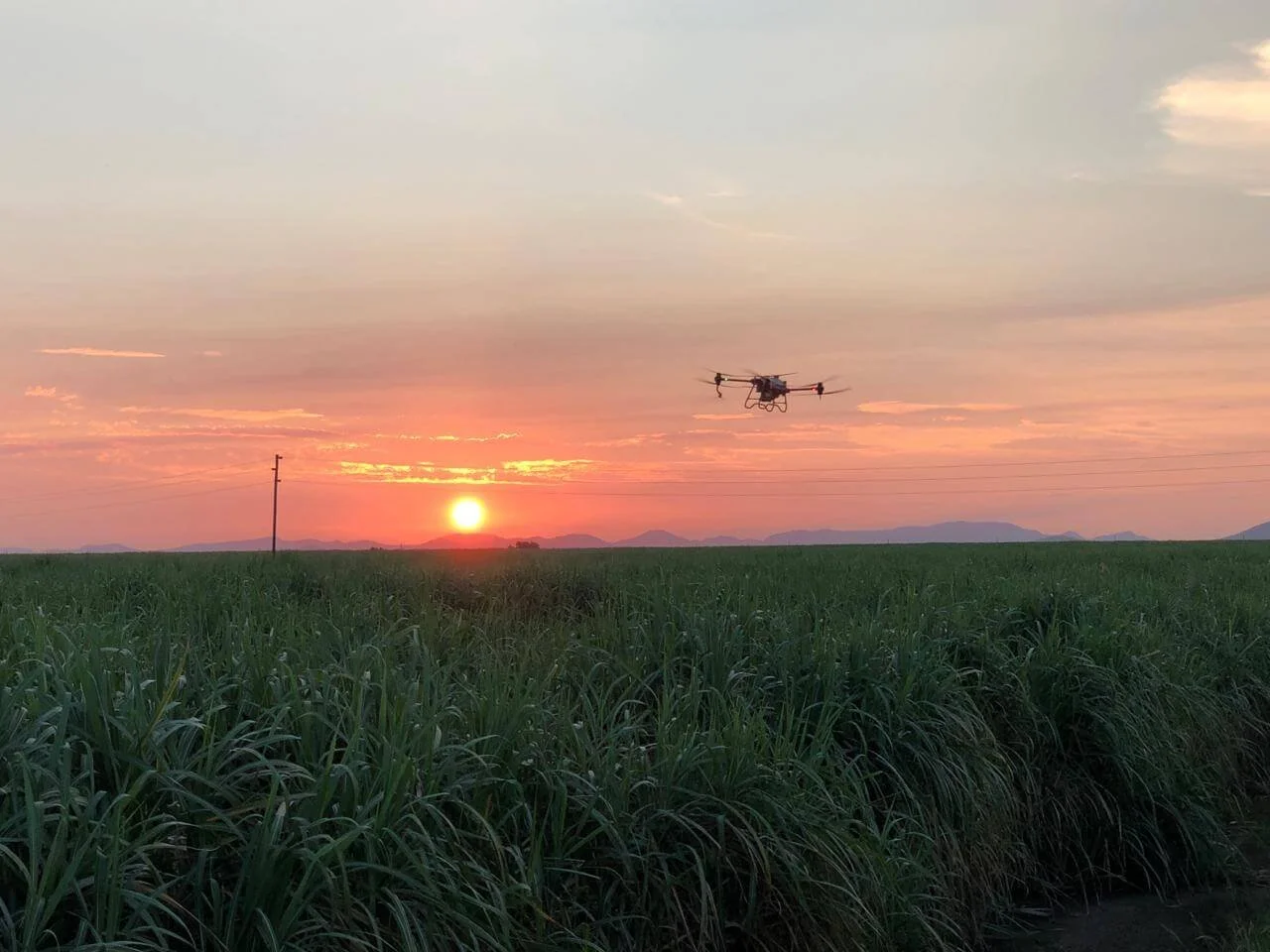
Smarter sugarcane field operations
Explore how agricultural drone technology can support sugarcane management and more efficient field workflows.
Read the case study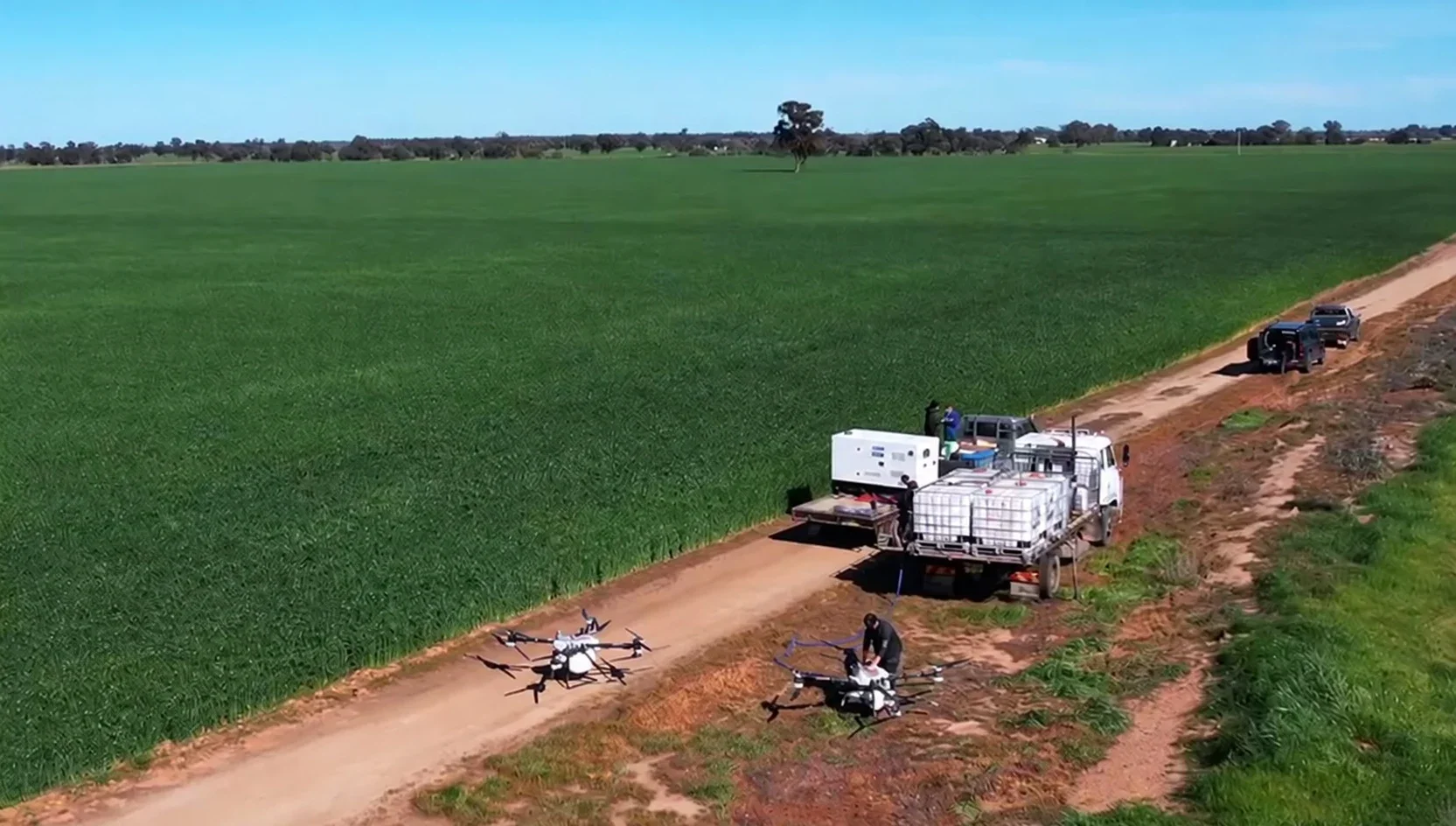
Precision agriculture for wheat
Discover practical applications of agricultural drones in wheat fields, from targeted treatment to streamlined operations.
Read the case studyMore stories coming soon
Stay tuned for more real-world DJI Agriculture applications and success stories.
Stories and results are based on published global agricultural case studies and EE Group Australia's local case studies. Outcomes may vary depending on farm, crop and operating conditions.
Agriculture in Focus
Discover grower experiences, product unboxings, and field demonstrations showcasing DJI Agriculture solutions.
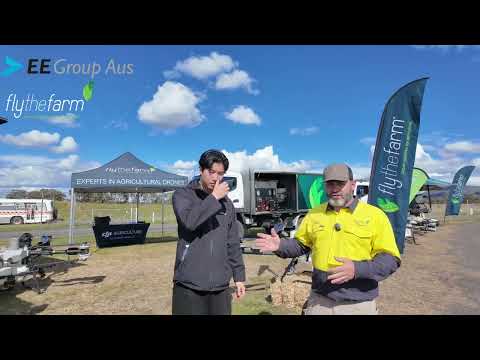
EE Talk With Fly The Farm -- The Fuel Advantage Of Farming Drone Operation
EE Group talks with Fly The Farm about fuel use in agricultural drone operations and what potential savings could mean for growers.

DJI AGRAS T100 Unboxing | Big Drone, Big Jobs
Get a first look at the product, its design and what's included in the box.

DJI Agras T70P Unboxing Video
Explore the product up close, from its packaging and components to its overall design.

EE Talk With Phil -- Wheat Management Workflow
Every wheat field has a story. Hear Phil discuss the challenges he faces on his farm, how DJI Agras drones have helped him tackle them, and the lessons learned along the way.

EE talk with Swift Drone Solution -- Weed Control Workflow
Watch another video in our interview collection and hear first-hand perspectives on agricultural technology and its real-world applications.

EE Talk with Agras partners - Agridrone
Explore another video conversation in our interview collection, with perspectives on agricultural operations and technology in practice.

DJI Agras T70P: Field Test Flight
Experience the DJI Agras T70P in action with a field test flight showcasing its flight performance and operation.
Where to Buy
Find an authorised EE Group DJI Agriculture dealer near you. Select a state, search by name or town, or tap a marker on the map.
DJI Agriculture Knowledge Base – Q&A
Find practical answers about DJI Agras models, getting started, spraying, spreading, maintenance, troubleshooting and operating requirements in Australia.
Products and Buying
7 questionsWhat payload does each of the four models carry?
Spraying payload: T100 100 kg, T70P 70 kg, T50 40 kg, T25P 20 kg. Spreading payload: T100 100 kg, T70P 70 kg, T50 50 kg, T25P 25 kg.
Which model is right for me?
Choose the T100 for broadacre work and contract spraying, the T70P for general farm operations, the T50 for small farms, and the T25P for small paddocks and one-person operation. For specifications side by side, see the DJI Agras model guide.
Which models support lifting?
The T100 (up to 100 kg) and the T70P (up to 65 kg). The T50 and T25P do not. See the lifting-system details for the DJI Agras T100 and DJI Agras T70P.
Can one aircraft both spray and spread?
Yes. All four models can switch between the spraying system and the spreading system. Our Queensland sugarcane case study shows these two applications in a farm setting.
Which remote controller does each model use? Are they interchangeable?
The T100, T70P and T25P use the DJI RC Plus 2; the T50 uses the DJI RC Plus. The T100 and T70P controllers are interchangeable. The T25P controller is not interchangeable with those two.
How do the obstacle sensing systems differ?
The T100 has LiDAR, millimetre-wave radar and a quad-vision system. The T70P and T25P have millimetre-wave radar and a tri-vision system. The T50 has phased-array radar and a binocular vision system.
Can I fit four nozzles?
Yes. All four models can take an optional second pair of nozzles. Maximum flow rises from 30 L/min to 40 L/min (T100, T70P), or from 16 L/min to 24 L/min (T50, T25P).
Getting Started
7 questionsWhat should I do first with a new drone?
Check the contents against the packing list and inspect for transport damage. Then charge, activate, update the firmware, calibrate, and finish with a test flight using clean water. If anything is missing or damaged, contact your dealer before powering on for the first time. For a broader introduction, read the agricultural drones beginner’s guide.
How do I activate the aircraft?
Power on the remote controller, sign in to the DJI Agras app with your DJI account and connect to the internet. Then power on the aircraft and follow the prompts. Activation is only needed once.
Do I need to update the firmware?
Yes. When the app prompts you, update the aircraft, remote controller, batteries and charger to the latest version. Keep everything well charged and do not power off during the update.
Can I fly without RTK?
Yes, but horizontal positioning accuracy drops from about ±10 cm to about ±0.6 m. We recommend always using RTK for automatic route operations.
When do I need to calibrate the compass?
Calibrate when the app prompts you. Stay away from vehicles, metal and electrical infrastructure while calibrating.
What should I watch for on the first flight?
Test with clean water first. Hover and check the controls, then fly a short automatic route and confirm the spray is even and the flow rate is stable.
What should I check before each job?
Arm locks tight, propellers undamaged, batteries firmly seated, sensors clean, no leaks in the lines, RTK fixed, and no warnings in the app. Also confirm obstacles in the paddock such as power lines and trees.
Spraying
9 questionsCan the droplet size be adjusted?
Yes. On all four models the droplet size is adjustable from 50 to 500 µm. The DJI Agras T100 spraying-system page explains its atomisation equipment.
What droplet size should I choose?
Follow the chemical label. In general, use coarser droplets for products with a high drift risk such as herbicides, and finer droplets for fungicides and insecticides that need to penetrate the canopy. The finer the droplet, the higher the drift risk.
What is the spray width of each model?
5–12 m for the T100, 4–10 m for the T70P and T50, and 4–7 m for the T25P. Actual width varies with flight height, droplet size and wind, so we recommend measuring it with water-sensitive paper.
What is the maximum spray flow rate of each model?
The T100 and T70P deliver 30 L/min (2 nozzles) or 40 L/min (4 nozzles). The T50 and T25P deliver 16 L/min (2 nozzles) or 24 L/min (4 nozzles).
When do I need to run a flow calibration?
Before the first spray job on a new aircraft; after replacing a nozzle, pump or flow meter; after switching to a liquid with a noticeably different viscosity; and when the actual application rate clearly differs from what the app shows.
How do I run a flow calibration?
Fill the tank with clean water, bleed the air from the lines, then follow the prompts in the spraying system settings in the app.
Which chemicals can be applied by drone?
Only products whose label permits aerial application, used in line with the label's aerial application directions. For typical crop-protection uses, see our agricultural drone applications guide.
Can I spray in the rain?
We do not recommend it. Rain reduces chemical efficacy and affects the sensors, so spraying should stop.
What is single-side spraying for?
The T70P and T25P support single-side spraying, which improves coverage along paddock boundaries and around obstacles.
Spreading
9 questionsWhat is the spreading tank volume and payload of each model?
T100: 150 L / 100 kg. T70P: 100 L / 70 kg. T50: 75 L / 50 kg. T25P: 30 L / 25 kg. Compare the four aircraft in the DJI Agras model guide.
What is the maximum spreading flow rate of each model?
400 kg/min for the T100 and T70P, 190 kg/min for the T25P, and 108 kg/min for the T50. These figures are for compound fertiliser.
What is the spread width?
3–10 m for the T100 and T70P, 3–8 m for the T25P, and 8 m for the T50.
What materials can be spread?
Dry granular materials such as fertiliser, seed, feed and granular pesticides. The T100 and T70P suit granules of 0.5–10 mm (depending on the feeder); the T50 and T25P suit 0.5–5 mm. The Queensland sugarcane case study includes an example of granular fertiliser spreading.
How do I choose a feeder for the T100 and T70P?
Standard: extra-large (0.5–10 mm; fertiliser, wheat, feed) and medium (4–6 mm; rice). Optional: large (4–10 mm; rice, fertiliser) and small (0.5–4 mm; canola seed, granular herbicides and insecticides). Choose by application rate per hectare and granule size. Feeder configurations are covered on the DJI Agras T100 and T70P product pages.
Do I need to recalibrate after changing material?
Yes. Run a material calibration in the app for every new material. Recalibrate as well when the batch changes or the moisture content changes noticeably.
Are the T70P and T100 spreading systems interchangeable?
The spreaders are interchangeable; the tanks are not. The T25P spreading system is not interchangeable with either.
Are there requirements for the material?
It must be dry and free of lumps. Damp fertiliser will block the feeder.
Do I need to clean up after spreading?
Yes. Fertiliser is highly corrosive. After each day's work, empty any leftover material, wash the feeder and spinner disc, and dry them thoroughly.
Batteries and Charging
9 questionsWhich battery does each model use?
Which charger and generator does each model use?
The T100 and T70P use the C12000 or C10000 charger, or the D14000iE generator. The T50 uses the C10000 or C8000. The T25P uses the C8000.
How long does it take to charge one battery?
Fast charging (30% to 95%) takes about 8–11 minutes for the T100 and T70P, and about 9–12 minutes for the T50 and T25P. Actual time varies with air temperature, power supply and cooling conditions.
Can I charge a battery straight after a flight?
If the battery is too hot, the charger waits automatically. Keeping the battery in a cool, ventilated place or using the air-cooled heat sink shortens the wait.
Can the D14000iE generator charge batteries from mains power?
No. To charge from mains power, purchase a charger separately.
What power supply does the C12000 charger need?
Full output of 12,000 W requires a three-phase input. Have an electrician confirm the site power supply before connecting.
What should I keep in mind for day-to-day battery use?
Keep the connectors clean and dry, keep batteries out of direct sun, number them and rotate their use, and return to home promptly on a low-battery warning.
How should batteries be stored long term?
Store them at the charge level recommended in the manual; never leave them fully charged or depleted for long periods. Keep them in a dry, cool, ventilated place away from chemicals, fertiliser and heat sources, and check the charge level regularly.
When must a battery be taken out of service?
Do not use or charge a battery that is deformed, swollen, leaking or has taken in water. Contact after-sales support.
Cleaning and Maintenance
10 questionsDo I need to clean the drone after each day's work?
Yes. Chemical and fertiliser residue is the main cause of corrosion and faults.
How do I clean the spraying system?
Fill the tank with clean water and run the spray to flush the lines, pumps and nozzles until the water runs clear. Then remove and wash the tank filter and nozzle filters.
Can I hose down the airframe?
Yes. Power off and remove the battery first, close all port covers, rinse with clean water and wipe dry. Do not aim a pressure washer at connectors, motors or sensors, and do not submerge the aircraft.
How do I clean the radar and cameras?
Wipe the surfaces with a soft cloth. Dirty sensors affect obstacle avoidance and terrain following.
What should I do before switching to a different chemical?
Flush the tank and lines thoroughly. When alternating between herbicides and other products, use a tank cleaner as the label directs to prevent crop damage.
How do I dispose of the rinse water?
Dispose of it in line with the chemical label and local regulations. Never discharge it into drains, channels or water sources.
Which parts should I inspect regularly?
Propellers, motors, arm locks, fasteners, lines and fittings, nozzle spinner discs, cables and connectors, landing gear and the tank. For component diagrams and part identification, use the DJI Agras Part Finder.
Can I keep using a propeller with a small chip?
No. Replace propellers in pairs if a blade is cracked, chipped or deformed. The DJI Agras Part Finder can help you identify the correct replacement.
How often is servicing required?
Follow the intervals in the maintenance manual for your model, or take the aircraft to an authorised service centre when the app prompts for maintenance.
How should I store the drone at the end of the season?
Clean it thoroughly and drain all water from the tank, pumps and lines. Once dry, fold it and store it indoors in a dry, ventilated place out of direct light. Remove the batteries and store them separately.
Troubleshooting
14 questionsRTK will not fix or keeps dropping out. What should I do?
Set up the base station on high, open ground, check the remote controller's network connection and the RTK service status, then reconnect.
Obstacle avoidance gives false alarms, or height hold is erratic. What should I do?
Wipe the radar and vision sensors clean with a soft cloth, then restart the aircraft. Strong backlight or low light can also affect the vision system.
The flow rate is low or nothing is spraying. What should I do?
Clean the filters and nozzles, bleed the air from the lines, check the lines for kinks, then run the flow calibration again.
The actual application rate is well off the set value. What should I do?
Clean the system and recalibrate with clean water, then check the spray width and speed settings in the app.
A nozzle is not spinning or atomisation has got worse. What should I do?
Clean the nozzle and remove any chemical crystallisation, replace the spinner disc if it is worn, and check for loose connectors.
The nozzles drip after spraying stops. What should I do?
Check the solenoid valves and the seals on the fittings.
Material is not feeding or is spreading unevenly. What should I do?
Switch to dry, lump-free material, confirm the feeder matches the material, then run the material calibration again.
I get a motor or ESC warning. What should I do?
Land immediately. Check the propellers and motors for damage or foreign objects, and load to the weight the app recommends. If the warning recurs, ground the aircraft and have it inspected.
The battery will not charge. What should I do?
Wait for the battery temperature to return to normal, clean the connectors, update the firmware, then cross-test with another battery.
The remote controller will not connect to the aircraft. What should I do?
Link them again, update both the remote controller and the aircraft to the latest firmware, and confirm the controller is compatible with that model.
The video feed stutters or drops out. What should I do?
Point the antennas at the aircraft and move to higher or more open ground. Use a relay module where trees or terrain block the signal.
A firmware update failed. What should I do?
Switch to a stable network, charge fully and try again. If it still fails, contact after-sales support.
When must I stop flying immediately?
After a collision or hard landing; if a structural part or propeller is cracked; if a battery is swollen, leaking or smoking; if there is abnormal vibration in flight; or if the same warning keeps recurring.
What should I have ready before contacting after-sales support?
The model and serial number, screenshots of the app error and the time it occurred, the firmware version, and photos or video of the affected part.
Licensing and Regulations (Australia)
10 questionsThe following is an overview only and is not legal advice. Check the regulators' current requirements before operating.
What flying licence do I need to operate an Agras drone?
All four models are medium RPA under CASA rules (more than 25 kg, not more than 150 kg). The pilot needs a remote pilot licence (RePL) with a rating for the specific model.
What else do I need to provide paid services to others?
You also need a remotely piloted aircraft operator's certificate (ReOC). You can hold your own or work for a business that holds one. Our beginner’s guide for Australian farmers covers further training and operating considerations.
Do I need a licence if I only fly on my own farm?
You need a RePL. You do not need a ReOC when operating over your own land without receiving any payment.
Do I need to be re-assessed to fly a different model?
A RePL for medium RPA is endorsed by specific model. You must obtain the rating for the new model before flying it.
Does the drone need to be registered?
Yes. Drones used for business or as part of your job must be registered with CASA.
Why is the T100 limited to 149.9 kg in Australia?
Above 150 kg it is no longer a medium RPA. DJI states that in Australia operators must follow local regulations and keep the maximum takeoff weight at 149.9 kg.
Do I need a pesticide licence to apply chemicals by drone?
Yes. This is regulated by each state and territory, and requirements differ. In New South Wales, the pilot must hold an EPA RPA applicator pilot licence and the business must hold an RPA applicator business licence.
How do I apply for the NSW applicator licences, and how long are they valid?
Apply through eConnect EPA. Licences are valid for five years.
Do I need to report a crash that causes a pesticide spill?
In New South Wales, the licensed business must notify the EPA. In other states, follow local requirements.
What must I record for each application?
Date and time, location, crop, product and rate, wind speed and direction, temperature, operator and licence number, and aircraft model. Keep records for the period your state requires.
After-Sales and Service
5 questionsHow long is the warranty and what does it cover?
The aircraft is covered for 1 year. Batteries are covered for 1 year or 1,500 charge cycles, whichever comes first. Wear parts are covered for 3 months and propellers for 15 days.
Where can I get repairs and servicing?
Contact your authorised dealer or an authorised service centre.
How do I buy spare parts?
Order genuine parts through an authorised dealer. Use the DJI Agras Part Finder to identify the parts before ordering through your dealer.
What should I do after a crash?
Make sure everyone is safe first. Power off and remove the battery, deal with any chemical spill, and photograph the scene. Do not power on again for a test flight. Have the photos and the aircraft serial number ready, upload the data for the flight in which the crash occurred, then contact after-sales support.
Where can I download user manuals and firmware?
User manuals are available on each model's download page on the DJI Agriculture website. Firmware is updated through the DJI Agras app.
Support

Repairs & Technical Support
Get assistance with DJI Agriculture product repairs, technical enquiries and service requests.
Submit a Service Request
Agriculture Part Finder
Find the right parts to keep your Agriculture operating.
Search parts